
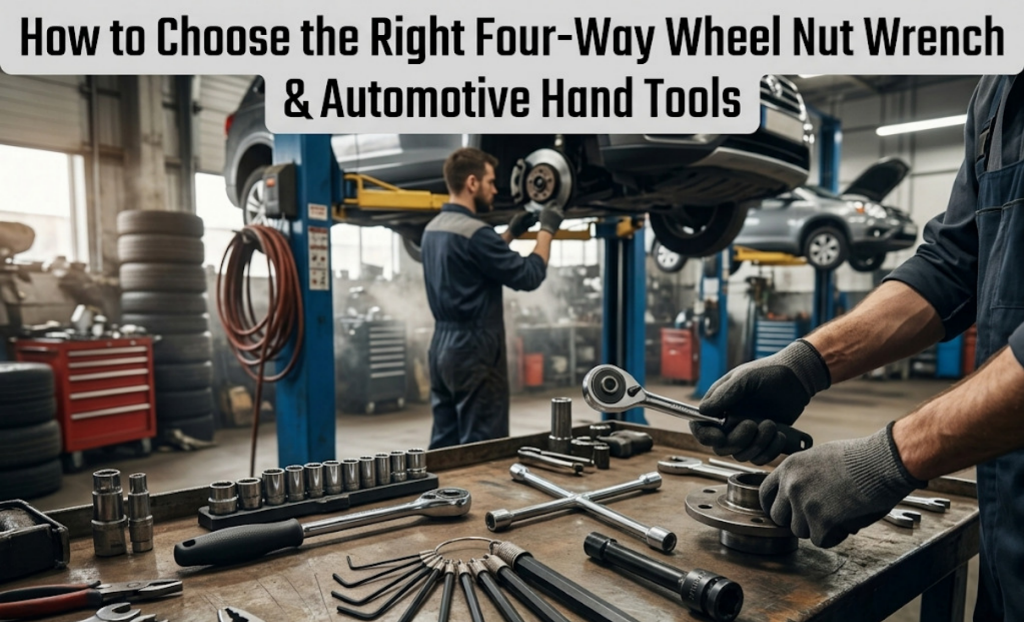
Every modern garage, tyre shop, and fleet maintenance center depends on the reliability of its manual tools. While pneumatic impact guns and hydraulic lifts get most of the attention, a heavy-duty four-way wheel nut wrench remains one of the most essential pieces of equipment on any workshop floor. Whether you are breaking loose stubborn, over-torqued lug nuts on a commercial truck or performing roadside tyre service, choosing the wrong automotive hand tools can lead to rounded fasteners, broken sockets, and injured technicians.
Furthermore, equipping your service bays with industrial-grade tools—from manual cross wrenches to complete diagnostic and DPF cleaning solution setups—directly determines your workshop’s daily turnaround time. In this comprehensive buyer’s guide, we will walk you through the exact specifications, metallurgy, sizing, and durability standards to look for when investing in wheel wrenches and bulk garage/tyre tools.
Why a Heavy-Duty Four-Way Wheel Nut Wrench Is Non-Negotiable
A four-way wheel nut wrench (also known as a cross rim wrench) features four permanently welded or forged arms arranged in an “X” shape, with a different socket size at each end. Unlike a standard single-arm L-wrench, the cross design delivers balanced, dual-handed leverage.
When a technician pushes down on one arm while pulling up on the opposite arm, pure rotational torque is applied directly to the lug nut. Consequently, this eliminates off-axis bending forces that commonly snap standard lug wrenches or strip wheel studs.
Key Advantages for Busy Workshops & Fleet Operators
- Zero Power Dependency: Unlike air impact wrenches or cordless guns, a manual cross wrench never runs out of battery or requires a compressed air line—making it indispensable for mobile breakdown vans and roadside assistance.
- Four Sizes in One Tool: Technicians do not waste valuable bay time hunting through toolboxes for individual sockets across different passenger cars, SUVs, and commercial LCVs.
- Superior Torque Control: When starting threads or performing final hand-tightening before using a calibrated torque wrench, a cross wrench gives mechanics tactile feedback to prevent cross-threading.
- Long-Term Durability: A forged alloy steel wrench lasts for years under daily abuse, offering an unbeatable return on investment for high-volume tyre shops.
6 Critical Factors When Buying a Four-Way Wheel Nut Wrench
Not all cross wrenches are built to handle commercial workshop loads. Cheap, cast-iron wrenches sold at local hardware stalls can twist or snap at the center weld under high torque. Before placing an order for your workshop, evaluate these six technical criteria.
1. Steel Grade and Forging Process
First and foremost, check the metallurgy of the tool. Always choose wrenches crafted from Chrome Vanadium (Cr-V) or Chrome Molybdenum (Cr-Mo) drop-forged alloy steel. Drop forging aligns the internal grain structure of the metal, giving it extraordinary tensile strength and shock resistance. Additionally, look for heat-treated and tempered sockets that resist flaring or cracking even when paired with a cheater bar.
2. Center Hub Reinforcement
The center intersection where the four arms meet endures the highest torsional stress. Superior models feature a forged center reinforcement plate or deep-welded cross-joint with a thick steel collar. Avoid wrenches with thin spot welds or hollow tubing at the center hub.
3. Socket Sizing (Passenger vs. Commercial Fleet)
Make sure the four socket ends match the vehicles your garage services daily:
- Passenger Cars & SUVs (Metric): Typically feature 17mm, 19mm, 21mm, and 22mm (or a 1/2-inch square drive adapter on one arm so you can attach specialty lock-nut sockets).
- Light Commercial Vehicles (LCVs) & Heavy Trucks: Require larger, heavy-duty truck cross wrenches featuring 24mm, 27mm, 30mm, and 32mm (or 33mm) deep-well sockets capable of reaching recessed dual-wheel lug nuts.
4. Arm Length and Leverage Ratio
Leverage is simple physics: longer arms multiply applied force. Standard passenger car cross wrenches measure between 14 inches (350 mm) and 16 inches (400 mm) across. However, for commercial trucks, buses, and agricultural tractors, choose a heavy-duty wrench with 20-inch to 24-inch (500 mm – 600 mm) arms so technicians can break loose rusted fasteners without excessive physical strain.
5. Socket Wall Thickness and Depth
Modern alloy wheels have tight lug wells. If a wrench has overly thick socket walls, it will scrape and damage expensive customer rims. Look for thin-walled yet high-tensile chamfered sockets that slide smoothly into recessed alloy wheel pockets while gripping the flat sides of the nut (flank-drive design) rather than the corners.
6. Corrosion-Resistant Surface Finish
Workshops expose tools to moisture, road salt, brake dust, and hydraulic fluids. A high-grade satin chrome finish, zinc plating, or black phosphate coating prevents rust formation and provides a secure, non-slip grip even when a mechanic’s hands are greasy.
Essential Automotive Hand Tools Every Modern Garage Needs
While upgrading your tyre bay with a reliable four-way wheel nut wrench, it is equally important to audit the rest of your manual toolkit. Standardizing your workshop bays with matched, professional-grade automotive hand tools prevents workflow bottlenecks and reduces tool replacement costs.
Here is a checklist of core hand tools that work alongside your wheel service equipment:
| Tool Category | Primary Workshop Application | What to Look For |
| Calibrated Torque Wrenches | Final lug nut tightening to OEM specs | Click-type mechanism, ±3% accuracy, Cr-Mo ratchet head |
| Tyre Levers & Bead Breakers | Manual tyre demounting and heavy-duty truck tyres | Forged manganese steel, smooth spooned tips to protect beads |
| Combination Spanner Sets | Suspension, brake caliper, and undercarriage bolts | 12-point ring end with 15° offset, drop-forged Cr-V steel |
| Heavy-Duty Breaker Bars | Loosening seized suspension and axle nuts | 24-inch length, flexible 180° Cr-Mo swivel head |
| Valve Core & TPMS Tools | Tyre inflation, deflation, and sensor servicing | Precision torque-limiting TPMS drivers, brass core removers |
| Dead-Blow & Rubber Mallets | Freeing corroded wheels stuck to hub flanges | Non-marring polyurethane shell, steel-shot filled head |
Integrating Hand Tools with Heavy Garage Equipment & Emission Solutions
To maximize revenue per square foot, successful garage owners combine top-tier hand tools with capital workshop machinery. For example, once a technician removes a wheel using a cross wrench and services the tyre, smooth bay operations depend on having calibrated wheel alignment, tyre changer, and hydraulic lifts ready for immediate use.
Moreover, commercial workshops servicing BS-VI diesel trucks and passenger fleets are increasingly expanding beyond mechanical repairs into exhaust aftertreatment maintenance. Adding a dedicated DPF cleaning solution—such as an automated DPF cleaning machine or specialized DPF cleaner—allows your garage to clean blocked particulate filters in-house rather than outsourcing the job. When evaluating a DPF cleaning machine in India or comparing DPF cleaning machine price/manufacturer options, pairing your heavy equipment bay with organized bulk garage/tyre tools ensures your technicians can handle everything from exhaust removal to final wheel torquing under one roof.
Smart Sourcing Tips: Buying Bulk Garage & Tyre Tools for Workshops
If you are setting up a new multi-bay service center, expanding a tyre franchise, or managing a corporate fleet maintenance depot, buying individual tools at retail prices eats directly into your capital budget. Follow these B2B procurement strategies to get the best value:
- Order Bulk Garage/Tyre Tools in Standardized Kits: Purchasing master mechanic tool sets and multi-pack wheel wrenches lowers your per-unit cost by 20% to 35% while ensuring every bay has identical tools.
- Verify Manufacturer Warranty & Compliance: Reputable automotive tool manufacturers adhere to international standards such as DIN (Deutsches Institut für Normung) and ANSI/ASME torque specifications. According to torque safety guidelines published by the Tire Industry Association (TIA) and mechanical standards from ASME International, using certified, properly sized wheel service tools is critical to preventing wheel-off incidents on highways.
- Leverage B2B Industrial & Auto Directories: When sourcing specialized equipment or comparing wholesale suppliers, check verified B2B industrial/auto directories and trade listings. Reviewing technical Q&As and verified buyer feedback on industrial portals helps you identify reliable manufacturers with readily available spare parts and after-sales support.
- Implement Shadow Boards & Tool Accountability: Store your cross wrenches, torque wrenches, and sockets on wall-mounted shadow boards or rolling tool trolleys. Visual inventory tracking eliminates misplaced tools and keeps service bays clutter-free.
Proper Maintenance & Safety Practices for Wheel Wrenches
Even the toughest drop-forged four-way wheel nut wrench requires basic care and safe handling to deliver maximum service life:
- Never Use an Overly Long Cheater Pipe: Sliding a 5-foot steel pipe over a standard passenger car cross wrench can exceed the yield strength of the alloy steel and snap the weld. Use a heavy-duty truck wrench or pneumatic impact gun for seized commercial lug nuts instead.
- Clean Sockets Regularly: Wipe away mud, grease, and metal shavings from inside the socket ends so the wrench seats fully over the lug nut flats.
- Always Finish with a Torque Wrench: Use your four-way wrench to spin lug nuts on smoothly and snug them down in a star pattern, then complete the final tightening using a calibrated torque wrench set to the vehicle manufacturer’s exact Newton-meter (Nm) specification.
Selecting the right four-way wheel nut wrench and automotive hand tools is a foundational investment in workshop speed, technician safety, and customer trust. By prioritizing drop-forged Chrome Vanadium steel, reinforced center hubs, accurate metric sizing, and bulk B2B procurement, your garage will eliminate tool failures and keep every service bay operating at peak efficiency.
Ready to Upgrade Your Workshop with Industrial-Grade Tyre & Hand Tools? Equip your mechanics with heavy-duty, drop-forged tools built to withstand daily commercial garage abuse. Browse our complete selection of cross rim wrenches, tyre service equipment, and bulk workshop tools at competitive B2B prices.
👉 Shop Heavy-Duty Four-Way Wheel Nut Wrenches & Automotive Hand Tools Today
Frequently Asked Questions (FAQs)
1. What is the best material for a heavy-duty four-way wheel nut wrench?
Drop-forged Chrome Vanadium (Cr-V) or Chrome Molybdenum (Cr-Mo) alloy steel with heat-treated sockets and a reinforced center hub is the best material. It provides superior tensile strength and prevents bending or snapping under high torque.
2. What socket sizes come on a standard four-way wheel nut wrench?
Standard passenger car and SUV cross wrenches typically include 17mm, 19mm, 21mm, and 22mm sockets (or a 1/2-inch drive head). Heavy-duty commercial truck wrenches feature 24mm, 27mm, 30mm, and 32mm sockets.
3. Why is a four-way cross wrench better than a standard L-shaped lug wrench?
A four-way wrench allows technicians to push and pull with both hands simultaneously on opposite arms. This creates balanced rotational torque, prevents the socket from slipping off the nut, and eliminates side-load bending that breaks L-wrenches.
4. Can I use a four-way wheel nut wrench for final lug nut tightening?
Use a four-way wrench to loosen nuts and snug them down evenly in a star pattern, but always perform final tightening with a calibrated torque wrench to meet the vehicle manufacturer’s exact torque specifications.
5. How can workshops save money when buying automotive hand tools?
Workshops can save 20% to 35% by purchasing bulk garage and tyre tools in standardized sets directly from specialized B2B automotive equipment suppliers rather than buying individual tools at retail prices.