
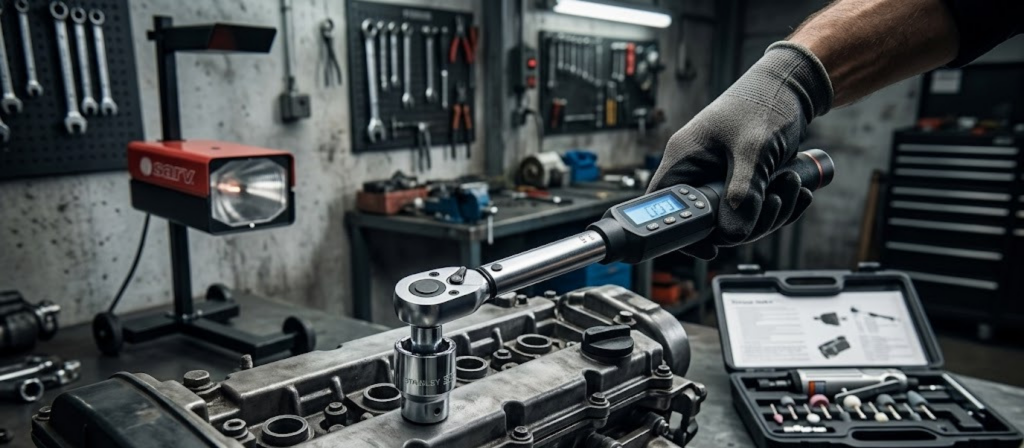
Modern internal combustion engines operate under extreme pressure, heat, and rotational forces. Every bolt, stud, and fastener inside an engine assembly holds vital parts together under exact mechanical tolerances. When you assemble these critical components, guessworking fastener tightness is a direct path to mechanical failure.
Investing in high-grade torque wrenches ensures that every bolt reaches its exact specified tension. Precision measurement tools prevent common repair mistakes, such as under-tightening or over-tightening critical engine fasteners. Understanding the mechanics of fastener tension explains why professional engine builders and mechanics rely on premium torque tools to protect sensitive engine components from premature wear, warping, and catastrophic failure.
Understanding Mechanical Torque in Engine Assembly
Torque measures the rotational force applied to a fastener, usually calculated in foot-pounds or Newton-meters . When you turn a bolt into an engine block or cylinder head, applying torque creates axial tension. This tension stretches the bolt slightly, acting like a stiff spring that holds the assembled components together.
This clamping force keeps critical engine parts properly seated. However, this clamping force must remain within a narrow, manufacturer-specified tolerance range.
Under-Torqued Fastener  --->  Insufficient Clamping Force  --->  Vibration, Fluid Leaks, Joint Failure
Over-Torqued Fastener   --->  Excessive Bolt Stretch        --->  Thread Stripping, Bolt Shearing, Component Warping
Exact Torqued Fastener  --->  Optimal Elastic Tension      --->  Reliable Joint Integrity & Long Service Life
Using low-quality, uncalibrated, or incorrect tools often leads to inconsistent torque delivery. High-grade torque wrenches deliver repeatable, verified torque settings to maintain structural integrity across every joint in the engine.
How Improper Torque Damages Engine Components
Using the wrong torque values leads to serious mechanical problems. Inaccurate tightening damages engine components in three distinct ways:
1. Component Warping and Distortion
Modern engines rely on aluminum alloy cylinder heads mated to cast iron or aluminum engine blocks. Aluminum expands and contracts rapidly with temperature changes.
If cylinder head bolts are tightened unevenly, the cylinder head flexes, leading to:
- Head gasket blowouts
- Coolant leaking into oil passages
- Compression losses across adjacent cylinders
- Out-of-round cylinder bores, causing piston ring blow-by
2. Thread Stripping and Block Damage
Engine blocks contain tapped threads designed to receive structural bolts. Applying excessive torque pulls thread material directly out of the softer aluminum block. Repairing stripped internal threads requires expensive thread inserts (such as Heli-Coils) or complete engine block replacement.
3. Fastener Shearing and Fatigue Failure
Fasteners operate within their elastic limit. When a bolt is stretched beyond its yield point due to over-torquing, it undergoes plastic deformation. It loses its ability to spring back, snaps under operational stress, or shears off entirely inside the engine block during operation.
The Benefits of High-Grade Precision Torque Wrenches
Standard clicker wrenches or basic beam torque tools may seem sufficient for general mechanical work. However, high-performance engines require precision tools with tight accuracy tolerances.
| Feature / Aspect | Standard / Budget Torque Wrench | High-Grade Precision Torque Wrench |
| Calibration Stability | Drifts quickly over repeated use | Retains accuracy over extended service cycles |
| Feedback Mechanism | Faint click or visual scale only | Auditory, tactile click, LED light, and digital display |
| Build Material | Basic steel, plastic internals | Hardened chrome-vanadium steel, metal internal gears |
| Torque Range Flexibility | Limited range, inaccurate at extremes | Wide linear scale with precise low-torque options |
Superior Calibration Accuracy
High-grade torque wrenches are calibrated according to strict ISO 6789 and ASME B107.300 standards. Premium tools guarantee accuracy within of the target setting, compared to budget models that can deviate by more than.
Durable Internal Mechanisms
Cheap torque wrenches utilize soft metal pawls and springs that degrade rapidly under load. High-grade tools feature hardened alloy steel internal drive gears, ensuring consistent performance even after thousands of cycles.
Clear Feedback Systems
High-grade electronic and mechanical torque wrenches provide clear auditory clicks, tactile vibration, and visual LED alerts. This multi-sensory feedback prevents over-torquing during high-speed workshop routines.
Critical Engine Components Protected by Precision Torque Tools
Precision torque control is vital across multiple areas of engine assembly.
+-------------------------------------------------------------------+
|               CRITICAL TORQUE-SENSITIVE ENGINE JOINTS             |
+-------------------------------------------------------------------+
| 1. Cylinder Head Bolts   -> Prevents head distortion & gasket failure |
| 2. Main Bearing Caps     -> Protects crankshaft rotation & clearance |
| 3. Connecting Rod Bolts  -> Prevents high-RPM rod bolt shearing     |
| 4. Spark Plugs & Sensors -> Protects soft aluminum thread bores   |
| 5. Intake & Oil Pan      -> Ensures even pressure on rubber gaskets  |
+-------------------------------------------------------------------+
Cylinder Head Bolts
Cylinder head bolts require strict step-by-step tightening sequences and torque-to-yield (TTY) measurements. High-grade torque wrenches deliver exact angular turn measurements (Angle Measurement Torque Wrenches) required for modern TTY bolts.
Main and Rod Bearing Caps
Crankshaft main bearings and connecting rod caps operate with clearances measured in thousandths of an inch. Over-tightening crushes oil clearance gaps, starving the engine of lubrication. Under-tightening allows bearing shells to rotate, destroying the crankshaft.
Spark Plugs and Threaded Sensors
Spark plugs screwed into aluminum cylinder heads require exact torque ($15\text{–}25\text{ }ft\text{-}lbs$). Under-torqued plugs back out and cause compression leaks; over-torqued plugs strip the aluminum threads out of the cylinder head.
Key Features to Look for in a Professional-Grade Torque Wrench
Selecting the right tool for engine assembly requires evaluating specific technical features:
- Digital vs. Mechanical Drive: Digital torque wrenches allow easy switching between units and record torque data logs for quality control.
- Angle Measurement Capabilities: Many modern engines require tightening fasteners to a baseline torque followed by a specific degree angle.
- Low-Torque Capabilities: Valve covers, oil pans, and intake manifolds require low-range measurement drive wrench on small bolts causes over-tightening.
- Certificate of Calibration: Always ensure the tool includes an NIST-traceable (or equivalent) calibration certificate from the manufacturer.
Proper Use and Maintenance of Precision Torque Tools
To maintain the accuracy of high-grade torque wrenches, follow proper workshop maintenance practices:
- Unwind Mechanical Wrenches After Use: Always return mechanical click-style torque wrenches to their lowest scale setting before storage to relieve internal spring tension.
- Avoid Using as a Breaker Bar: Never use a precision torque wrench to loosen stuck or frozen bolts. Reverse force damages internal measurement mechanisms.
- Perform Annual Calibration: Professional shops should re-calibrate torque wrenches annually or after every 5,000 cycles.
- Store in Protective Cases: Dropping a torque tool can knock its internal drive mechanism out of alignment. Always store tools in molded hard cases.
Protect Your Engines with Precision-Engineered Tools! Review official workplace safety standards and guidelines via the Health and Safety Executive (HSE) Guide to Vehicle Repair Safety or relevant regional OSHA standards.
Don’t compromise on engine reliability with unverified fasteners. Explore our premium selection of high-grade torque wrenches engineered for precision accuracy and maximum durability.
[Browse Our Professional Torque Tool Collection Today] or contact our technical team to find the exact measurement tools for your garage or engine building facility.
Why is using a high-grade torque wrench necessary for engine rebuilds?
Engine components operate under tight mechanical tolerances and high heat. High-grade torque wrenches ensure fasteners reach the exact target clamping force without stripping threads, shearing bolts, or warping aluminum components.
What is the difference between a mechanical clicker and a digital torque wrench?
A mechanical clicker wrench uses a calibrated spring and pawl that releases with an audible click when torque is reached. Digital torque wrenches use electronic strain gauges to provide real-time digital readouts, LED signals, angle measurement capabilities, and audio beeps.
How often should high-grade torque wrenches be calibrated?
Professional technicians should calibrate torque wrenches once a year or every 5,000 uses, whichever comes first. If a torque wrench is dropped or overloaded, calibrate it immediately before putting it back into service.
Can I use my torque wrench to loosen tight bolts?
No. Torque wrenches are designed solely for precision tightening. Using a torque wrench as a breaker bar subjects internal components to excessive force, ruining its calibration and permanently damaging the precision mechanism.
